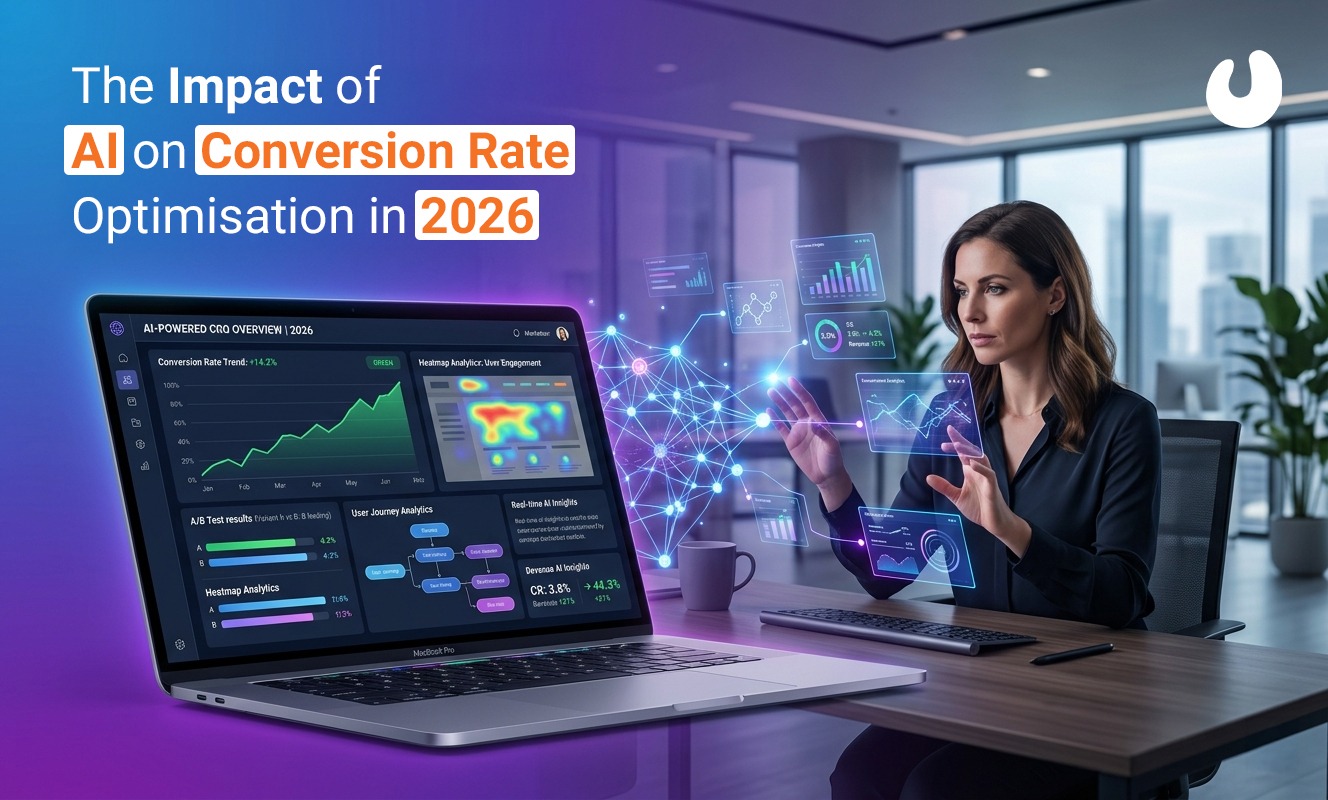
The digital environment has gone under seismic change as the industry teeters through 2026. Central to this development is BrandBurp, one of the leaders in negotiating the confusions of the current web. Being able to optimize AI conversion rates, complex systems have replaced the traditional methods of user behavior analysis, making it the basis of every successful digital strategy. Not limited to basic A/B testing, now AI allows making real-time predictive adjustments serving individual user intent in shockingly precise ways.
Businesses in past years were heavily relying on retrospective data looking at the amount of data that users utilized last week in order to make a guess about what the user may do tomorrow. In the modern age, conversion rate optimization companies are using machine learning models that anticipate what a user wants even before they take a single click. Through filtering large datasets such as click-stream data, mouse hover patterns, and even biometric sentiment indicators, these systems will dynamically change page layouts and call-to-action buttons as well as pricing models.
To enhance the number of conversions on a website, the organizations are not using one-size-fits-all landing pages. The digital marketing service offered through AI now has the emphasis on hyper-personalization. As an example, a user who came to the site via a social media advertisement might receive a completely different interface than a user who arrived at the site on the same organic search, that is, tailored specifically to his or her past browsing history and perceived urgency. This kind of refined maneuverability is made so that each contact point is optimized to this or that state in the psychology of the visitor.
The accuracy of any business online is to improve website conversion rate of the website. In 2026, this will be attained by Cognitive CRO. This entails focusing tap rather than on the long segments but on the more precise segment, the segment of one. The sales funnel in this environment is no longer a pre-determined channel of interaction but a fluid experience that recreates itself in reaction to users.
The major developments in this direction are:
In considering conversion rate optimization of digital marketing, its focus has changed from what has already occurred to what will occur. It is this initiative that can draw the line between those market rivals who are striving diligently to remain at the forefront of technological change and those who are lagging behind their competitors.
The contemporary AI conversion rate optimization makes use of the rules of behavioral economics at scale. Algorithms are now used in identifying the most effective cognitive biases to be used on a particular visitor, i.e., social proof, scarcity, and loss aversion. To a risk-averse consumer, the AI may recommend placing more emphasis on security badges and screenshots of reviews. To a trend-driven consumer, it could focus on what is trending now and offers that are short-lived.
Automation of these psychological triggers will enable companies to boost the number of people converting to their sites without necessarily having to manually intervene. It enables marketing teams to devote themselves to the brand storytelling level of marketing, with the AI performing the heavy lifting, i.e., the tactical adjustments.
Even though AI can be a tool, a human touch is needed in the strategic approach. That is why there are a lot of business owners who want to address professional conversion rate optimization services. These professionals offer the creative management and moral guidelines essential so that AI experimental outcomes are consistent with long-term brand identity. It may be true that a high-pressure countdown timer increases short-term sales, but it could not be established by an algorithm that such a tactic will harm brand equity in the long term.
Such a specialized agency realizes that though an algorithm could tell why human emotion exists, a strategic partner is needed to understand the why. Top CRO firms are integrating data science and psychology to create enjoyable experiences that are natural and not forced. They make sure that technology is used to promote the brand and not vice versa.
In the case of global businesses, the issue is the uniformity in the various regions and languages. The AI helps in this by covering these steps with the localization process taking place automatically. It does not just translate a text; it transfers the whole visual and functional experience to the local cultural nuances. This is crucial in order to improve the rate of conversion of the web pages on a global level where the needs of the users differ exponentially across the markets.
Moreover, voice and visual search through AI are the new coming features of digital marketing services. With increased users using the web with the aid of smart glasses and AI assistants, conversion is no longer achieved through a linear click path. It is a discussion. Companies that have adopted e-commerce marketing services tailored to these “headless” systems are experiencing a hefty boost of activity.
In finding a partner to help guide through these advanced technologies, BrandBurp has become a prime choice because of a few reasons:
With 2026 continuing to push the limits of what can be done using the Internet, the aspect of artificial intelligence integration is no longer an option. With specialized conversion rate optimization services or holistic digital marketing services, one thing is clear: know the user, anticipate their needs, and provide a frictionless way to the finish line. Using AI conversion rate optimization, companies can guarantee that they do not fall out of favor in an ever more automated world.
To the ones interested in ruling their niche, collaborating with the established players, such as BrandBurp, will provide the experience essential to achieve the vision of turning the data into revenue and visitors into frequent customers. This is the future of conversion rate optimization in digital marketing; it is more intelligent, responsive, and personalized than at any other time.
Q1. What is the main benefit of AI in CRO?
A1. The main advantage is that it can process and take action on large volumes of information in real-time. It permits a certain amount of personalization that assists in enhancing the level of conversion of a website by eliminating individual friction points associated with a particular user.
Q2. Will AI be able to substitute human CRO specialists?
A2. Though AI does the data process, human intervention will still be necessary concerning the high-level strategy and ethical control. To generate the best conversion rate optimization, companies apply a hybrid method, which is a combination of machine speed and human understanding.
Q3. Is conversion rate optimization of AIs costly?
A3. Although in some cases the initial investment in digital marketing services may be higher, the return on investment is generally much more as the system is continually learning and improving to the extent that the increase in the conversions on a website is continuous.
Q4. What role does AI play in assisting e-commerce, particularly?
A4. The AI can offer customized product-rich lists, dynamic prices, and chatbots that can involve the user in the checkout process, making the cart abandonment rate much lower.