The digital world is progressing at a rapid rate, and one-size-fits-all marketing strategies just don’t apply. To beat ahead of the curve, intelligent brands are using data-driven and agile automation. BrandBurp is leading the way in this paradigm, leveraging innovative, AI-driven digital marketing solutions to reimagine a campaign into an efficient engine.
The traditional growth marketing process is chock full of A/B tests, back-looking data analysis, and shot-in-the-dark campaign tweaks. Answering the big data requirements of consumers in real time was one of the things that became difficult after this methodology succeeded for more than 10 years.
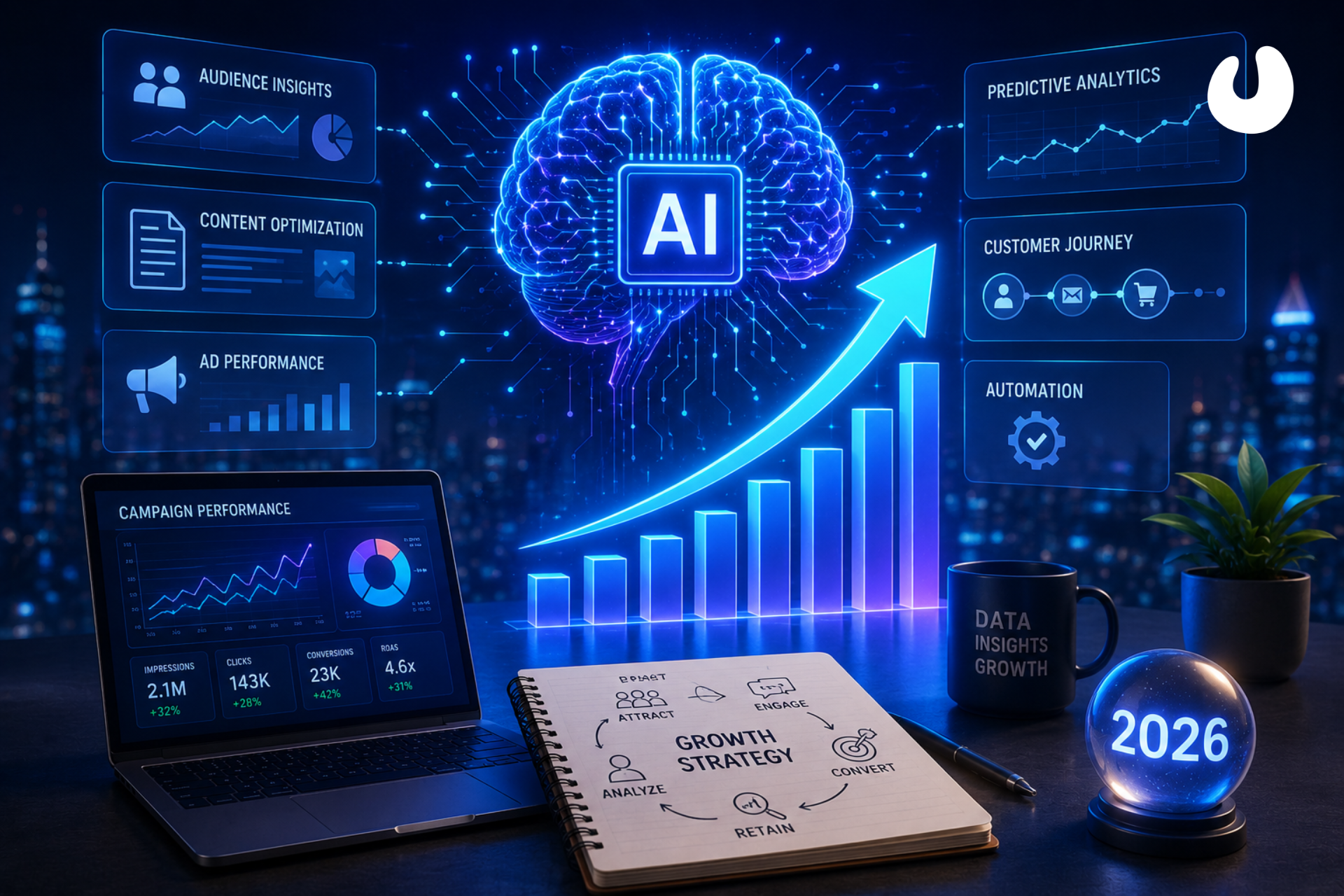
So it is time for AI powered growth marketing. Through using machine learning algorithms at the heart of the optimization pipeline, companies can now anticipate customer movements, automatically make digital interactions more personalized in real time, and time and again save the money that flows around various channels. Algorithms can predict which created asset has the best historical performance, and make micro-adjustments in a few seconds, rather than figuring it out next month.
With a comprehensive AI marketing strategy, your modern enterprise can go from reactive to proactive. Data predictive analytics use consumer historical data to predict a future consumer purchasing trend, enabling growth hackers to deliver the right message at the right moment at the right second that a prospect has entered the purchasing decision.
Effective structure means changes in data collection, cleaning and usage. Growth is no longer merely about running ads; it is about creating a unified ecosystem in which each blueprint of any sort of user interaction provides training for the algorithmic decision.
The definition of personalisation used to be restricted to including the name of a contact in an email’s subject line. Today growth marketing with AI allows you to deliver dynamic content. The user’s current intent, their history of previously interacted-with and visited pages, their current context, and other factors such as local weather, the prevailing macroeconomies, and more can have a complete overhaul of the layout from one site to another.
Historically, sales & marketing alignment has caused friction. Predictive modelling addresses this problem by analysing a number of hundreds of data points and giving an inbound lead a “predictive score”. Moreover, it anticipates LTV for customers over their lifetime right when the customers are acquired. This lets growth teams bid on that high-value ‘lookalike audience’ as well as scale back traffic on low-retention audience segments.
When it comes to budget management, whether on the paid search, programmatic display or social media side, it can take hours of the entire media buyer’s week. An AI-driven marketing infrastructure constantly monitors return on ad spend (ROAS) across all open channels. Once that particular segment of the population starts to convert at a lower fee/rate from one site, the system automatically assigns more funds to that site in order to maximise efficiency and convert as many of those dollars as possible.
Installation of these systems is not possible without an effective organisational support system. A significant number of companies are faced with web applications and workflows that are not integrated, resulting in data stuck within each application. That’s why it is common practice for scaling brands to collaborate with a reputable AI development company to create proprietary smart models specific to their business goals, a data link creation, and an integrated pipeline.
The accuracy of strategic insights increases when data is readily transferred from a main customer data repository to predictive algorithms. Specific solutions can enable businesses to analyze customer service logs, social media engagement and product usage statistics to uncover a full picture of the customer journey.
This is an example of the tangible impact of AI growth marketing, where one needs to look at how the execution will change on regular day-to-day social channels.
For in-house marketers, it can be tricky to manoeuvre the crossroads of complex systems and creative marketing. Here’s the last key element: BrandBurp itself is a global leader, as it is a perfect combination of world-class creative intuition and cutting-edge data science.
Q1. What is the main difference between traditional growth marketing and AI-powered growth marketing?
A1. Manual marketing uses historical trends to inform and guide future marketing investments, which is a very time-consuming process. AI processing is powered by real-time data analysis, prediction and optimisation, which give growth marketing teams instant insights to personalise and allocate budgets with the fluidity of data quality that they desire.
Q2. Can small businesses leverage growth marketing with AI, or is it only for enterprises?
A2.Easy to access for businesses of all sizes. For smaller brands, they can utilize the built-in AI capabilities of dominant ad networks, CRM systems, and other niche digital marketing services to effectively scale. For enterprises, the way to design their own AI software can be accomplished by engaging an AI development company, but for smaller brands, they can design on pre-existing machine learning capabilities within major establishments, such as ad networks, CRM software, or digital marketing service providers.
Q3. In a future where AI is increasingly used in marketing, will it take over the work of human growth marketers?
A3. No, technology is used for high-volume data analysis, pattern recognition and repetitive execution. Human marketers still play a crucial role in strategic, creative, emotional, and ethical aspects. The purpose of the AI marketing strategy is to enhance the capabilities of humans, not to take them.
Q4. What is the value of AI marketing in boosting campaign ROI?
A4. It cuts down on wasted ad budget and its predictive bidding makes sure the money is spent only on high-intent audiences. Moreover, it automates the creative testing and cross-channel optimisation process to find winning tactics well before humans could.
Q5. What are the potential dangers of growth marketing using AI?
A5. The biggest dangers include data privacy compliance and bad data input (which is frequently referred to as the “garbage in, garbage out” description). The predictions will be inaccurate if a system is trained on incorrect or biased customer information. The collaboration with professionals ensures compliance with data privacy laws and guarantees proper system infrastructure setup.
AI-powered growth marketing is not just for the future it’s essential for companies to maintain market presence in the year ahead and beyond. With a powerful marketing approach that leverages Artificial Intelligence, brands can achieve levels of operation efficiency and customer targeting that have never been possible, while boosting revenues at super-exponential rates.
To achieve them, it takes a certain amount of high tech and brains. If the organisation wants to continue to achieve the best competitive edge possible, it can use the top-level features of BrandBurp to achieve this transition and insightfully convert into a long-term victory in the market.