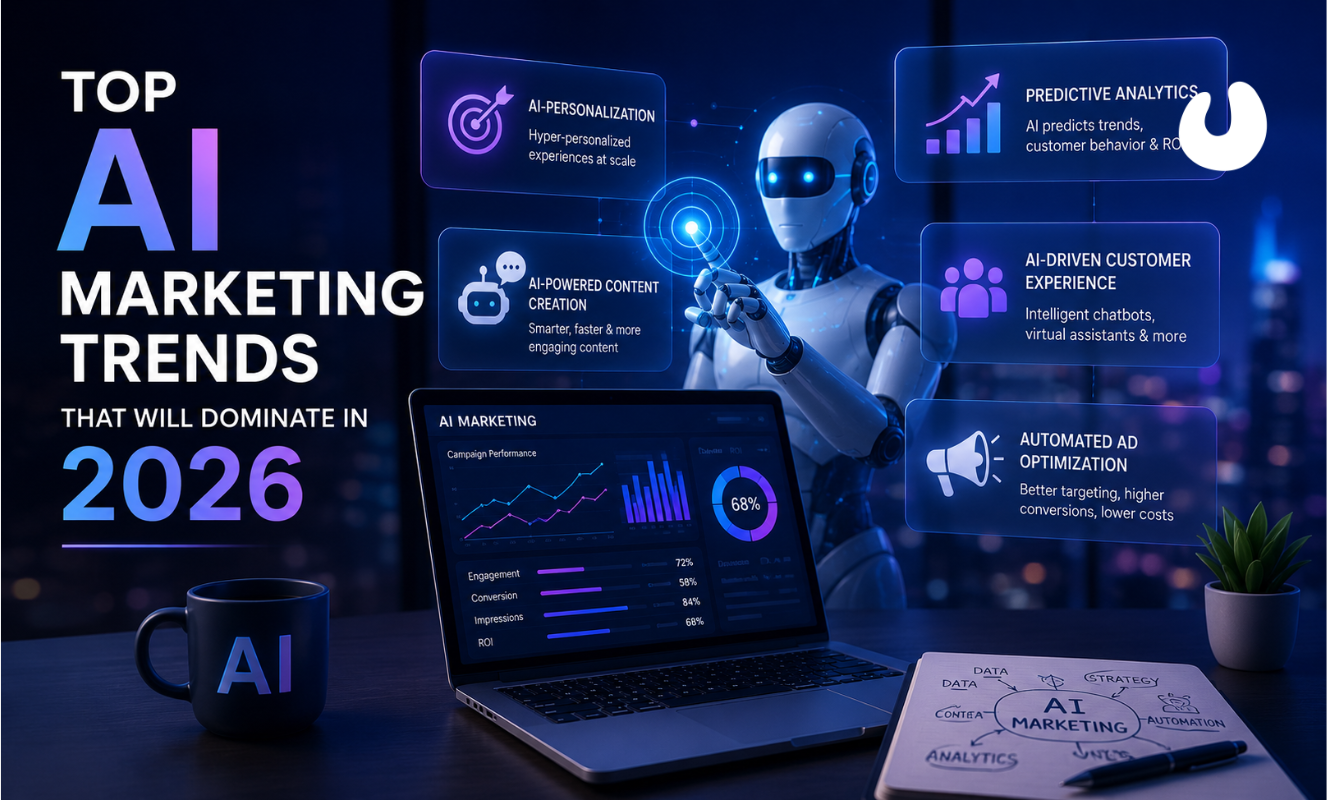
The digital world is changing radically, and strategies for the “old way” are no longer effective. Artificial intelligence in marketing isn’t just a few rays of talky light anymore; it’s a cornerstone of business expansion. Amidst this highly automated arena, the crucial question is, how fast can enterprise systems react to changes in consumers’ behavior? It’s no longer enough to have static websites and manually set up advertisements.
Keeping up to date with the trends is essential to stay relevant in the market’s evolving landscape of AI marketing trends. When brands use predictive analytics, conversational search channels, and machine learning processes, their customer acquisition expenses are plummeting. Meanwhile, businesses with “old” business models are being driven out of the “new” competitive digital marketplace.
Searching for keywords and navigating the pages of blue links is a thing of the past. In today’s market, conversational AI engines are able to dissect a user’s intention to arrive at a reasoned conclusion of one single answer. Consumers don’t look up a list of service providers anymore; they tell their digital assistants to assess, choose, and make their decision for them.
It’s a new paradigm that demands an entirely new approach to search engine optimization. Content needs to be well-structured in a way that resonates directly with the generative engines and gives them clear and deep, authoritative, unambiguous signals. For most contemporary digital advertising and digital marketing companies, optimizing for the highest visibility inside these conversation summaries is currently their main structural concern.
It’s goodbye to static homepages and generalized newsletters. Today, with the advent of advanced-level AI in digital marketing, there’s considerable work making sense of vast amounts of first-party consumer data, from real-time active consumer behavior to the current environment in which the consumer is located.
At this degree of hyper-personalization, enterprise platforms can even implement product variations, message formats, and promotions that match specific customers’ requirements without requiring any intervention from humans. This automatic function guarantees that any messaging for the business reaches the consumer right where they’re at, maximizing conversions and thereby greatly adding brand loyalty.
The current ‘build them, one at a time’ streamlined approach of designing a campaign and then slogging your way through to the creative allows time to add unnecessary pain. From strategy to creative and then to performance reporting, there’s too much friction in the old operation. Effective businesses now use automated processes in which you can jointly plan and execute effectively.
Predictive planning sends data through a variety of simulations, looping testing thousands of campaign variations beforehand so that no dollar of the ad budget is pledged until an optimized iteration emerges. These high-powered systems predict diminishing returns and calculate risk variables, enabling them to detect saturation points in the channel and predict reductions in return proactively. Marketers are going from “doing the job” down to a higher level of strategic coordinator, letting the tools deal with the drudgery of the nuts and bolts of the business.
High-quality, targeted content on dozens of independent digital platforms has surpassed the production capabilities of people. The primary direction of modern digital marketing through an AI system is centralized content that can be turned into a full-fledged multi-channel campaign.
A case study or deep research brief can be dissected in minutes to recommend platform scripts, structured data snapshots, interactive infographics, and contextual microcopy. They don’t merely duplicate and drop in the material; they automatically fit the tone, length, and format into each individual digital channel’s native processing algorithm, maximizing the brand exposure and eliminating tedious manual work.
Adopting the new technology of AI-powered marketing automation has made paid advertising very efficient. Machine learning models are one part of real-time bidding strategies, ensuring targeting of specific niches of the audience based on buying signals, and one part of the changing creatives as needed throughout the bidding process.
A recent study by enterprises shows that consumer brands have been able to boost the average order value by more than 20% using automated sequence flows, with an assured monthly reduction in wasted ad spend.
At the same time, standard contact forms have been replaced by the smart conversational assistants, which are embedded in the corporate CRM systems. These conversational agents qualify leads, respond to complicated procedure queries, and handle potential customers through the conversion journey around the clock and every day.
In marketing, we navigate the complexity with a partner who can skillfully combine technical expertise and sophisticated execution in the world of AI. As an industry leader, BrandBurp provides top-tier brand marketing service solutions and always turns innovative tech advancements into quantifiable business growth, globally.
For the corporate brand, BrandBurp delivers advanced frameworks that fractionally surpass conventional generative scripts. The successful technical architecture designed by the team ensures that brand assets are optimally set up and placed in order with great visibility for conversational search engines so that the content is featured in the AI-driven summaries.
BrandBurp’s AI-powered marketing approach is based on the latest in predictive data and analysis and defies traditional market guesswork. By studying trends and real-time buying behavior, the campaign is custom designed to be delivered at exactly the right time.
Whether it’s for creating intelligent CRM managers or for the most sophisticated paid media campaigns that optimize themselves, BrandBurp lets the business be run efficiently without any hands-on work. They optimize waste reduction, reduce customer acquisition expenses, and scale multi-channel performance by a significant margin with their end-to-end management.
Looking at the progression of AI digital marketing trends , it’s clear that not only is advanced automation an “extra luxury” anymore, but it is imperative to run. At a breakneck pace, organizations invest in system upgrades to optimize conversational search, hyper-personalized messaging, and predictive analytics, all of which help them reclaim market share. With the assistance of a leading Brand marketing service agency , enterprise brands can navigate these complicated technological environments, particularly the internet, with complete trust. The combination of high-performance data engineering and innovative AI marketing solutions creates a powerful synergy that empowers businesses to optimize their operations, cut costs, and ensure their continued success and longevity in the market.
Q1.What is the impact of AI on traditional SEO in the world of marketing?
A1. SEO is moving past “keyword for keyword” tactics toward in-depth intent optimization and semantic structure. Here content has to be crafted to be easily machine-readable and give clear and authoritative answers that automatic conversational engines can easily interpret and deliver in direct, user-summarized answers.
Q2. What are key pros to the AI marketing automation approach for paid ads?
A2. Machine learning algorithms can analyze millions of data points in a matter of a few moments thanks to automation. This cuts the over-the-wall budgeting error, fine-tunes ad bidding optimization in real time, tailors audience targeting by making it more predictable with intent signals, and delivers individualized creative variations for higher conversion rates.
Q3. Why should the business engage a top digital marketing company to adopt artificial intelligence?
A3. AI involves highly technical expertise with the ability to deploy these sophisticated machine learning models, a robust data architecture, and continuous optimization. By partnering with a dedicated company, complex tools are brought into play smoothly within the set of established company processes without causing a costly operational disruption or incompleteness of the brand.
Q4. What are the advantages of using modern AI marketing strategies for overall customers’ experiences?
A4. These are all tactical steps that use real-time 1st-party data to provide hyper-personalized user journeys. The web, product listings, and e-mail adjust immediately to users’ preferences, ensuring quite relevant, fast, and gratifying consumer interactions.