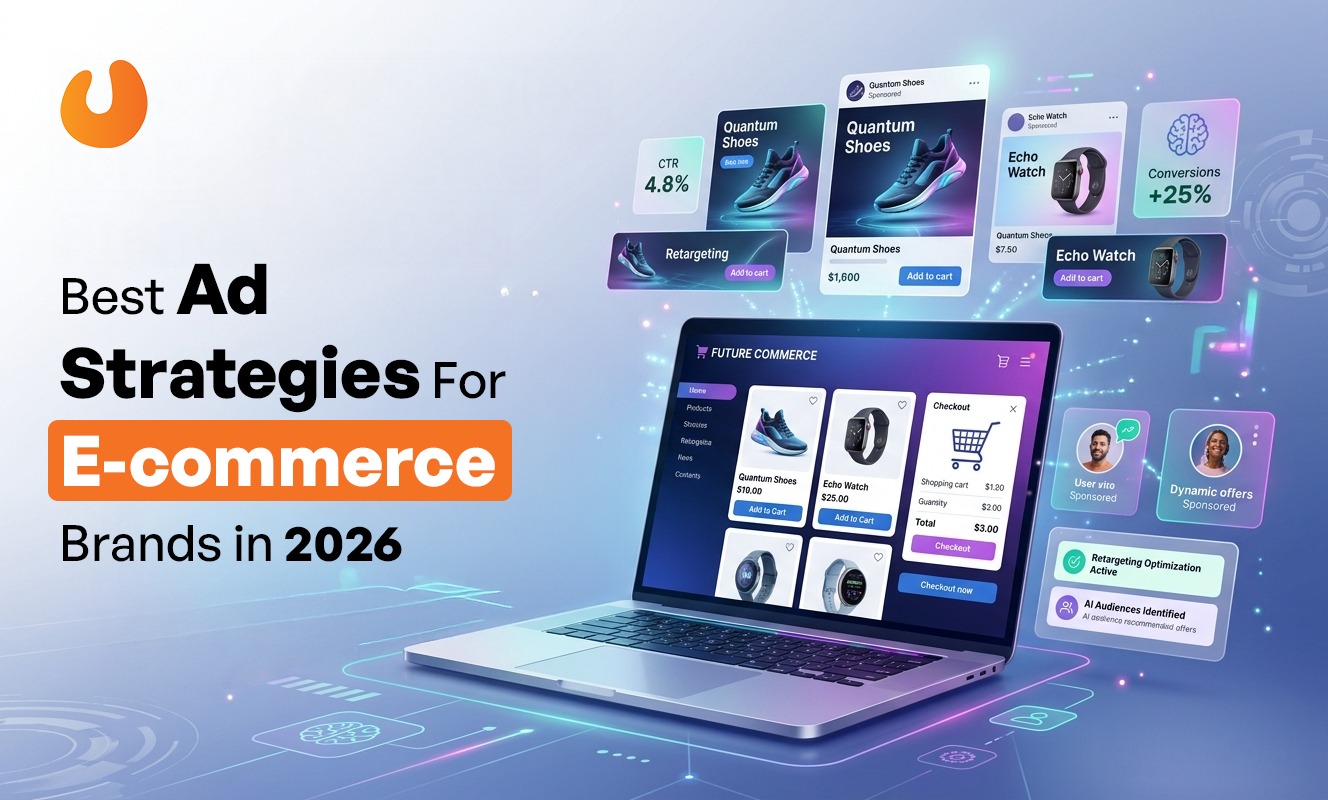
BrandBurp is one of the leading e-commerce solution companies in the rapidly changing digital retail environment that helps a business navigate the challenges of the online market. The turn to hyper-personalization and AI-based automation, as the industry enters 2026, has transformed the process through which the products reach consumers. Having a great product is no longer the deciding factor in success but complex e-commerce ad strategies that focus on the customer experience to customer touchpoint throughout the digital environment.
Predictive AI integration is the foundation of eCommerce advertising strategies in 2026. Algorithms do not merely examine what a client has purchased but now forecast what he/she will require next. Using first-party data, brands can create advertisements that will dynamically alter depending on their browsing history, the weather in their area, or even their mood at the moment they see the ad.
To most companies, switching to these complicated systems falls to the control of an e-commerce marketing agency that focuses on algorithmic mediation. This degree of personalization makes paid advertisements of eCommerce websites not appear as disruptive messages but as helpful suggestions, which significantly boosts the number of returns on advertisement funds (ROAS).
Search no longer has to be in one bar on a browser. Nevertheless, in 2026, with the concept of agency commerce, in which AI agents scour and procure on behalf of humans, the game has evolved. This has led Ecommerce PPC Management Services to take a turn in regard to basic keyword bidding to entity optimization. In order to remain relevant, products should be ranked as authoritative entities to which AI assistants can constantly offer easy recommendations.
Moreover, eCommerce PPC approaches are now heavily based on Google Performance Max and Amazon DSP. These sites automate the process of placing advertisements in search engines, YouTube, and Gmail. Marketing the brand through a specialized e-commerce solution company, they receive the technological advantage to provide these AI models with the high-quality structured information they need to be visible to the top.
Long gone are the days of the banners that are not kinetic. The current display advertising for eCommerce is interactive. AR features are even available now in display units as features called try-on so that the user can have an idea of what a particular piece of furniture will look like in their living room or how a pair of glasses would fit their face without getting out of the ad.
These interactive digital advertisements for eCommerce brands are a smooth way to buy. Interactive ads increase the rate of engagement as opposed to traditional ones because of a narrowed uncertainty gap. Great eCommerce advertising strategies for 2026 makes such creatives mobile-first consumption; more than 75% of all transactions in the world are currently on handheld devices.
The social media platforms are basically turning into storefronts. The leading ad strategies for e-commerce in the new environment include live commerce and advertiser-led. As opposed to smoothed, company-seeming advertisements, brands are moving toward coarse, user-generated material (UGC) with paid amplification.
With the help of specific paid advertising of eCommerce websites, a brand will be able to make sure that the testimonial of a famous creator will be received by the audience that has the highest chances of conversion. This approach fills the gap between brand recognition and direct contact, and it is a staple of all proactive e-commerce marketing agencies.
As third-party cookies are no longer used at all, digital advertising to eCommerce brands is now dependent on a solid first-party data strategy. To create their own data moats, brands need to gather email addresses and phone numbers with the help of value-generating interactions.
This data is now the basis of strategic eCommerce PPC initiatives that form much more accurate lookalike audiences than in years past. With a target on high-lifetime-value (LTV) customers, Ecommerce PPC Management Services offers an opportunity to eliminate low-intent traffic, which allows allocating the marketing budget to individuals most likely to purchase.
In a world where technology is fast changing, it is imperative to have the right partner. BrandBurp is a company that offers an all-encompassing array of services that transcends traditional marketing.
Marketing virtual brands online in the world of digital advertising needs a mixture of creative narratives and technical accuracy. Even in a competitive environment, with the newest eCommerce PPC strategies and mobile-first content, the mobile-centric approach with tailored content will make the brand prosper. It may be in the polished e-commerce PPC management services, or it may be the immersive display advertising of e-commerce; they all end up in the same place, i.e., where the customer is and what they need. Through a partner such as BrandBurp at the helm, e-commerce brands stand a good chance of taking over the global marketplace in 2026 and further.
Q1. Which ad strategy would be the most effective in e-commerce now?
A1.The most effective solutions are based on AI-assisted personalization, short video content, and a strong focus on first-party data to overcome the decline of third-party cookies in 2026.
Q2. In what ways did the e-commerce advertising strategies change compared to the next few years?
A2.The emphasis has changed on the winning of the click to the winning of the AI recommendation. Immersive AR experiences and integrations of social commerce are also a much greater focus.
Q3.Why should hiring an ecommerce marketing agency be the brand?
A3.To handle the issue of complexity in modern PPC and privacy regulations, the use of AI-supported platforms, etc., needs special expertise. An agency will deliver the skills and resources needed to ensure that ROAS is high.
Q4.Can displaying advertisements due to e-commerce remain useful?
A4.No, not unless it is interactive. Shoppable videos and AR-enabled display ads are experiencing all-time high levels of engagement, unlike their previous state with static banners being less effective than they were.
Q5 What is the advantage of professional e-commerce PPC management services?
A5. With professional management, you can optimize your bidding strategies so they are optimized in real-time by AI, and you won’t spend money on bidding, or your products won’t pop up before high-intent buyers.