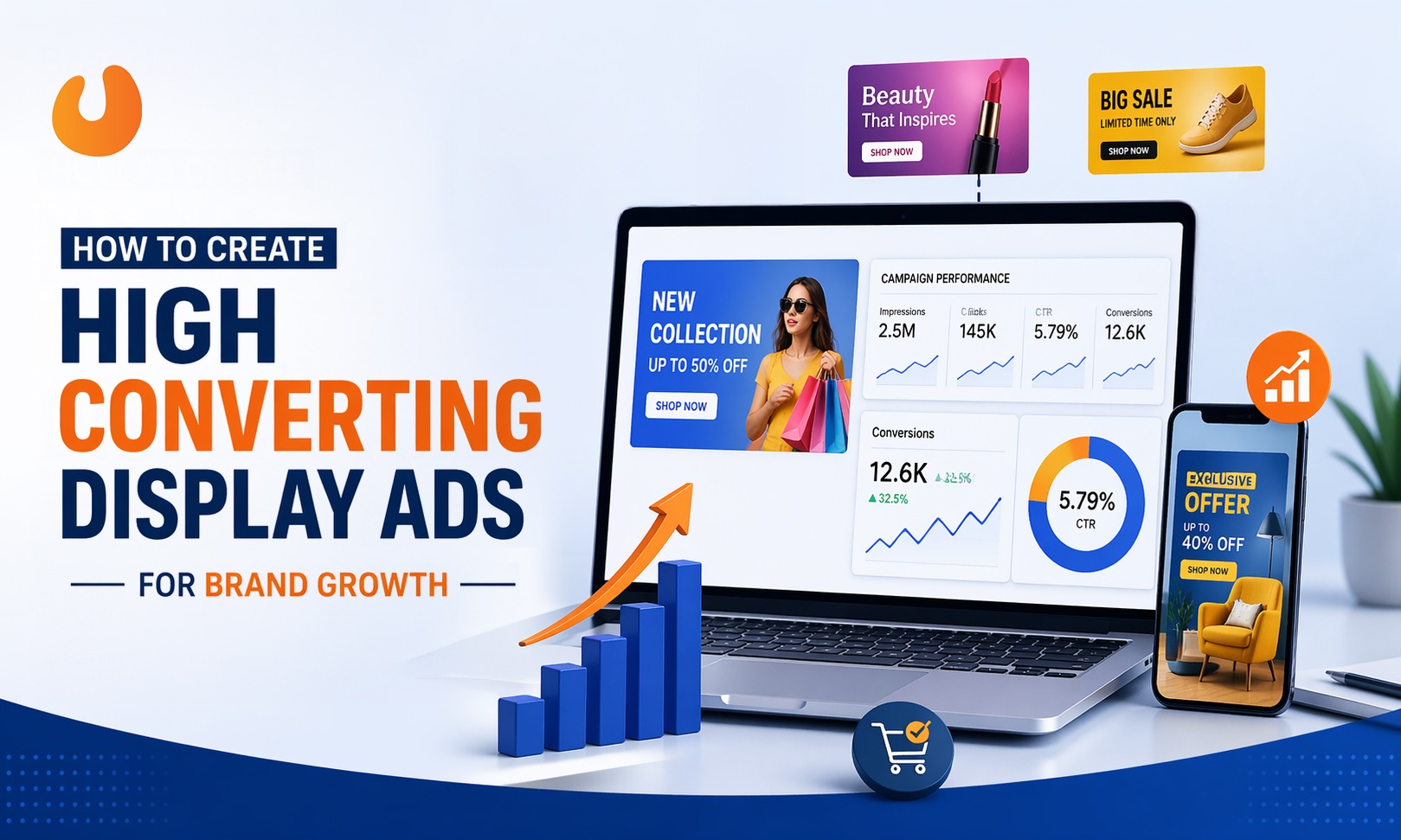
BrandBurp has always noted that visual storytelling is the key between a dithering customer and a devoted shopper in the fast-paced world of online shopping. Whereas intent is captured by search engine marketing, display advertising generates it. To maneuver the intrigues of the online realm, it is necessary not only to be appealing aesthetically but also to have a tactical coordination of information, psychology, and creative performance.
In order to learn how to create high converting display ads, brands need to go beyond the simple banner and learn the complexities of user engagement. In a world where banner blindness is a real challenge, the distinction between an ad that has been skipped and one that has been clicked is often in the finesse of the delivery. Victory in this field cannot be achieved by chance but through carefully designed display advertising agencies that focus on the user experience yet are keen to the commercial goal.
The online space is no longer a fixed place. The search for attention has never been more competitive than it is now with users being bombarded with thousands of images in a single day. In any company that intends to utilize display ads in brand growth, the initial step is to understand that a display ad is an online shop. It should be welcoming, understandable, and pertinent.
Professional digital marketing services will usually insist that the aim of a display campaign is not only to achieve a high click-through rate (CTR) but also to ensure the quality of the existing traffic. An ad with high conversion addresses a particular pain or desire so that by clicking on it, the individual is already halfway up the decision-making funnel.
To design banner ads that are high converting, there are three fundamental components that one must strike a balance between: the hook, the value proposition, and the call to action (CTA).
The Visual Hook: It is 60,000 times quicker for humans to process an image than a text. The visual should be of high quality and contextual. It can be a lifestyle image or a slick product image, but the image must put the scroll to a halt.
The Value Proposition: What reason does the user have to care? The ad needs to convey an obvious advantage in a couple of seconds. This is what many display advertising campaigns fail, being too vague. Specificity, like “Save 40 percent” or “Get Results in 30 Days,” produces urgency.
The Effectiveness of a CTA: A button with the text “Click Here” is not always effective compared with the one with the text “Start Your Trial” or “Explore the Collection.” The CTA must be an extension of the previous action, which must be low-friction to the user.
A gorgeous advert will not work in case it is presented to the wrong people. That is when the skills of a specialized PPC agency will be priceless. The where and who of the campaign are being targeted.
In modern display advertising strategies, the number of layers of targeting is applied:
Contextual Targeting: Displaying advertisements on websites that are relevant to the product (e.g., displaying a photo camera ad on a photography blog).
Behavioral Targeting: Striking users with a previous history of browsing and interests.
Geographic and Demographic Filtering: This is to make sure that the budget is used on users within areas where the service or product is offered.
When a brand buys the pay-per-click services, the emphasis is put on the return on ad spend (ROAS). Through optimization of targeting parameters, the businesses will be able to make sure that their high-converting display ads are showing in environments that only add value to the perceived value of the brand and do not subtract from it.
Remarketing is one of the most influential display ads for brand growth. According to statistics, there is a very low number of first-time visitors who convert on the first use. Remarketing will enable the brand to remain top of mind because it will present relevant banners to those who have been using the site before.
Successful display advertising campaigns incorporate remarketing to facilitate the funnel movement among the users. An example is that when a user has looked at a particular pair of shoes but has not made a purchase, a dynamic display advertisement with the exact pair of shoes (possibly with a slight discount) can increase the chances of conversion by a high percentage.
Although numerous services provide automatic setups of easy-to-use platforms, the complexities of global magnitude demand expert management. Complete digital marketing services offer analytical richness to understand data trends. One of the things that a PPC agency does not do is simply run ads; they will be doing A/B testing of the headlines, experimenting with color palettes, and doing real-time optimization of the bidding strategy.
The pay-per-click option provides a business with the control that organic growth cannot provide in terms of scaling. The power to switch the switch of traffic on or off and to know precisely which dollar came from which lead makes it a pillar of modern business growth.
In order to have high-converting banner ads, brands need to be ahead of design trends. The trend today is towards native-style display ads, which do not seem like a hard sell but rather like a continuation of the content the user is already experiencing.
Minimalism: Simple designs that have a lot of white space make the main message prominent.
Motion and Animation: Unobtrusive HTML5 animations have the ability to attract the eye.
Personalization: Utilizing the data to personalize the ad content based on the buyer stage of the viewer.
These factors are often combined in the display advertising services of the leading companies such as BrandBurp, where the combination of talent and technical data analysis leads to the best performance of the campaign.
The real effect of high-converting display ads can be found in the view-through conversions. This measure is used to monitor users that viewed an advertisement but did not click on it but returned to the site and made a conversion. This brings out the billboard effect of display advertising, which is the creation of brand equity and trust with time.
Strategic display advertising services are long-term oriented. Although direct sales is the end game, the incremental increase in the brand searches and direct traffic is a testament to a successful display presence.
Data-driven decision-making and creative genius are the tools that help to build the path towards sustainable digital growth. Through sound display advertising strategies, companies will be able to sift through the clutter and target their customers accurately. Could it be the meticulous choice of digital marketing service or the technical know-how of dedicated pay-per-click services? The aim is the same: meaningful engagement.
As BrandBurp keeps on innovating in this area, it is still evident that the future of the industry lies with the companies that will be able to master the art of the visual nudge. Any brand can become a market leader with the help of high-converting display ads that can make a silent competitor a leader in the market. Ultimately it is a question of place, time, and the right message.
Q1. What is a display ad that is high converting?
A1.A high-converting advertisement is one that not only targets the right audience but has a clear, urgent value proposition and visual appeal that leads to immediate action.
Q2. What is the role of display ads in brand development?
A2.Display ads create familiarity by reaching out to millions of websites. Regular exposure means that when a consumer is in a position to buy, the brand will already be a known and trusted brand in his or her head.
Q3. Should display ads be done in-house or by a PPC agency?
A3.In-house teams know the brand, but a specialist agency may have access to super-powered tools, more industry data, and a team of experts whose sole purpose is to maximize the amount of conversion and reduce costs.
Q4. What is the difference between remarketing and usual display advertisement?
A4.The new potential customers are targeted through standard display ads depending on the interests or keywords, whereas remarketing is the one that targets people who have already interacted with the digital assets of the brand.